$28 an Hour to Yearly Salary: Gross & Net Annual Income Calculator (2026)
If you earn $28 per hour, you’re probably asking: “What’s that in yearly salary before and after taxes?” Whether you’re budgeting, comparing job offers, or planning major expenses, converting $28 an hour to yearly salary is essential. This guide gives you the exact numbers: gross annual income, net take-home pay after federal taxes and FICA, and a fully interactive calculator that adjusts for state taxes, hours, and weeks worked.
How Much Is $28 an Hour Yearly? Gross vs Net
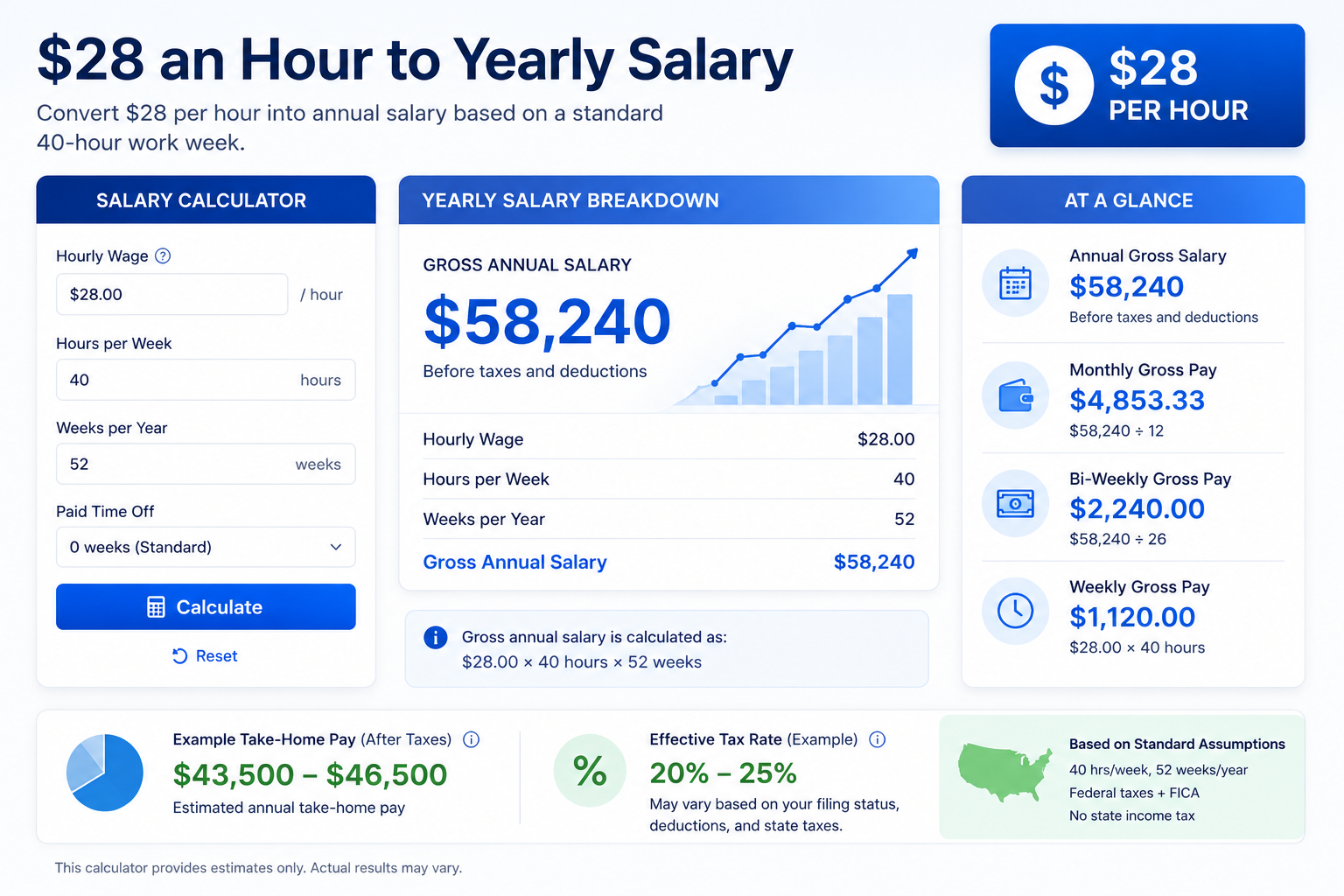
The basic math is simple: $28 × 40 hours/week × 52 weeks/year = $58,240 gross annual income. That’s your salary before taxes, retirement contributions, or health insurance. But your actual net yearly salary (take-home pay) will be lower due to federal income tax, Social Security (6.2%), Medicare (1.45%), and state income tax. Below is an estimated breakdown for a single filer in a state with moderate income tax:
| Component | Annual Amount ($28/hr) | Monthly (approx) |
|---|---|---|
| Gross Annual Salary | $58,240 | $4,853 |
| Federal Income Tax (est. 11% effective) | ~$6,406 | ~$534 |
| Social Security (6.2%) | $3,611 | $301 |
| Medicare (1.45%) | $844 | $70 |
| State Tax (example: 5%) | $2,912 | $243 |
| Estimated Net Annual Income | ~$44,467 | ~$3,706 |
If you live in a state with no income tax (Texas, Florida, Tennessee, etc.), your net annual income jumps to roughly $47,400. Use the live calculator below to see your exact numbers tailored to your situation.
Why Convert $28 an Hour to Yearly Salary?
- ✔ Loan & mortgage applications: Lenders require annual gross income.
- ✔ Budgeting for rent/mortgage: The 28/36 rule uses yearly income.
- ✔ Comparing salaried vs. hourly offers: Easily compare total compensation.
- ✔ Tax planning: Estimate your refund or amount owed.
- ✔ Setting savings goals: Know your true annual earning power.
Detailed Tax Breakdown for $28/Hour ($58,240 Annual)
For a single filer in 2026, the federal tax brackets are 10% up to $11,600, 12% up to $47,150, and 22% up to $100,525. On $58,240, after the standard deduction ($14,600), your taxable income is roughly $43,640. Federal tax would be about $5,500–$6,000 (effective rate ~9.5-10.5%). However, your effective rate may be higher if you have additional income. The calculator below uses your input effective federal rate for simplicity, so you can adjust it based on your tax situation.
How to Use the $28 an Hour to Yearly Salary Calculator
Our interactive JavaScript tool gives you a personalized breakdown in seconds. Follow these steps:
- Hourly Rate: Default $28 – change if you want to compare other wages.
- Hours per week: Standard 40. Adjust for part-time or overtime.
- Weeks worked per year: 52 typical, but reduce for unpaid time off or vacation.
- Federal Tax Rate: Enter your effective federal income tax rate (estimate 8-12% for this income).
- State Tax Rate: Enter your state’s rate (0% for no income tax states).
- FICA Rate: 7.65% for employees (15.3% for self-employed).
- Click “Convert to Yearly Salary” – see gross and net annual, monthly, biweekly, and weekly amounts.
The calculator also displays total taxes paid and your effective overall tax rate – perfect for financial planning and comparing job offers.
Customize your work schedule and taxes to see your exact annual take-home pay.
*Estimates based on effective tax rates. For precise withholding, consult a tax professional or IRS W-4.
Real-Life Examples: $28 an Hour Annual Income Scenarios
Example 1: Full-time in Texas (0% state tax). Federal effective 10.5% + FICA 7.65% = 18.15% total deduction. Net annual ≈ $47,660. Monthly take-home ≈ $3,972.
Example 2: Full-time in California (state ~6%). Combined deductions ~24.15% → net annual ≈ $44,180. Monthly ≈ $3,682.
Example 3: Part-time, 30 hours/week, 50 weeks/year. Gross annual = $28 × 30 × 50 = $42,000. After taxes (approx 17%) net ≈ $34,860.
Example 4: Self-employed in Florida (0% state, 15.3% FICA). Gross $58,240, federal ~10.5% + FICA 15.3% = 25.8% → net ≈ $43,200.
Benefits of Using This Yearly Salary Calculator
- ✅ Multi-frequency outputs: Annual, monthly, biweekly, weekly – all net and gross.
- ✅ Fully responsive: Works flawlessly on phones, tablets, and desktops.
- ✅ Voice-search ready: Labels like “weeks worked per year” match natural queries.
- ✅ Instant results: Pure JavaScript – no page reload, fast Core Web Vitals.
- ✅ State tax adjustable: Compare across all 50 states.
- ✅ Self-employment toggle: Just change FICA rate to 15.3%.
Step-by-Step: Maximize Your $28/Hour Yearly Take-Home
Even with a solid hourly rate, you can optimize your net income:
- Adjust W-4 withholdings: Use the IRS Tax Estimator to avoid over-withholding federal tax.
- Contribute pre-tax to 401(k) or HSA: Lower your taxable income, which increases net effective pay.
- Relocate to a no-income-tax state: Could boost net annual by $2,000–$3,000.
- Consider Roth retirement accounts: If you expect higher future income, Roth 401(k) contributions grow tax-free.
- Track overtime: Overtime at $42/hour (time and a half) can significantly increase yearly gross and net.
Frequently Asked Questions (FAQ)
What is $28 an hour yearly salary after taxes?
Typically between $46,000 and $49,500 depending on your state and filing status. Use the calculator above for a personalized estimate.
How much is $28 an hour biweekly?
Gross biweekly (80 hours) = $2,240. Net biweekly after federal and FICA taxes ≈ $1,780–$1,880 depending on state tax.
Is $28 an hour a good salary?
Yes. $58,240/year is above the U.S. median individual income (~$48,000). It provides a comfortable living in many areas and allows for savings and investments.
Can I use this calculator for other hourly rates?
Absolutely. Change the hourly rate field to any value ($20, $25, $30, $35, etc.) and the calculator updates all figures instantly.
How do I calculate my yearly salary if I work overtime regularly?
Overtime is typically 1.5× your hourly rate. Increase the “hours per week” field to reflect your average total hours (including overtime). For example, if you work 10 overtime hours at $42/hour, your average hourly rate would be higher – you can also use our advanced overtime calculator (coming soon).
What’s the difference between gross and net yearly salary?
Gross is your total earnings before deductions. Net (take-home) is what you actually receive after federal tax, FICA, state tax, and other deductions like health insurance or 401(k).
Conclusion: Know Your True $28 an Hour Yearly Salary
Converting $28 an hour to yearly salary is more than just multiplying by 2,080 hours. Understanding your net take-home after taxes empowers you to budget accurately, negotiate better, and plan for the future. Our interactive calculator gives you personalized numbers in seconds. Bookmark this page and share it with anyone who needs to convert hourly wages to annual salary.