States with the Lowest Income Taxes vs Highest: 2026 Comparison & Calculator
Where you live can dramatically change your take-home pay. Some states take a big bite of your earnings, while others take nothing at all. Understanding states with the lowest income taxes and those with the highest can save you thousands of dollars each year. Whether you’re planning a move, negotiating a remote job, or just curious, this guide breaks down the best and worst states for income tax — and includes a powerful calculator to compare your net pay side‑by‑side.
Lowest Income Tax States (The Tax‑Friendly Nine)
Nine states have no personal income tax at all. They fund government services through sales, property, or other taxes. These are the best places to maximize your paycheck:
- Alaska – 0% No income tax
- Florida – 0% No income tax
- Nevada – 0% No income tax
- New Hampshire – 0% on wages (dividends/interest taxed, but phasing out) No wage tax
- South Dakota – 0% No income tax
- Tennessee – 0% No income tax
- Texas – 0% No income tax
- Washington – 0% (capital gains tax on high earners, but no wage tax) No wage tax
- Wyoming – 0% No income tax
Additionally, New Hampshire is phasing out its tax on dividends and interest, moving toward zero. Washington has a 7% capital gains tax on certain high earners, but no tax on ordinary wages.
Highest Income Tax States (The High‑Tax Bracket Leaders)
On the other end of the spectrum, these states impose the highest top marginal income tax rates. For high earners, the difference can be eye‑watering.
- California – Top rate 13.3% (plus 1% surcharge for mental health, effectively 14.3%) Highest in US
- Hawaii – Top rate 11%
- New York – Top rate 10.9% (NYC adds another ~3.876%)
- New Jersey – Top rate 10.75%
- Oregon – Top rate 9.9%
- Minnesota – Top rate 9.85%
- District of Columbia – Top rate 9.9% (treated like a state for tax purposes)
- Illinois – Flat rate 4.95%, but often considered moderate; however, combined with high property tax.
For middle‑income earners, states like Iowa, Pennsylvania, and Georgia have moderate flat or low graduated rates. But the top 5 states above take the biggest percentage from high wages.
How Your State Income Tax Affects Your Paycheck
State income tax is withheld from your paycheck just like federal tax. It directly reduces your net take‑home. If you earn $80,000 per year in Texas, you pay $0 in state tax. The same income in California (assuming single filer, after deductions) could cost you roughly $4,000–$5,000 in state tax. That’s $330–$420 less per month in your pocket. For higher incomes, the gap widens dramatically.
Marginal vs. Effective State Tax Rates
Many people confuse the top bracket with what they actually pay. Your effective state tax rate (total state tax ÷ total income) is usually lower than the top bracket. For example, a Californian earning $150,000 might pay around 7-8% effective, not the full 13.3%. Still, that’s thousands of dollars.
Tax Comparison Table: Low vs. High States
| State | Top Marginal Rate | Effective Rate on $100k (est.) | Annual State Tax on $100k |
|---|---|---|---|
| Texas | 0% | 0% | $0 |
| Florida | 0% | 0% | $0 |
| Alaska | 0% | 0% | $0 |
| California | 13.3% | ~6.5% | $6,500 |
| New York | 10.9% | ~5.8% | $5,800 |
| New Jersey | 10.75% | ~5.5% | $5,500 |
Interactive Tax Comparison Calculator
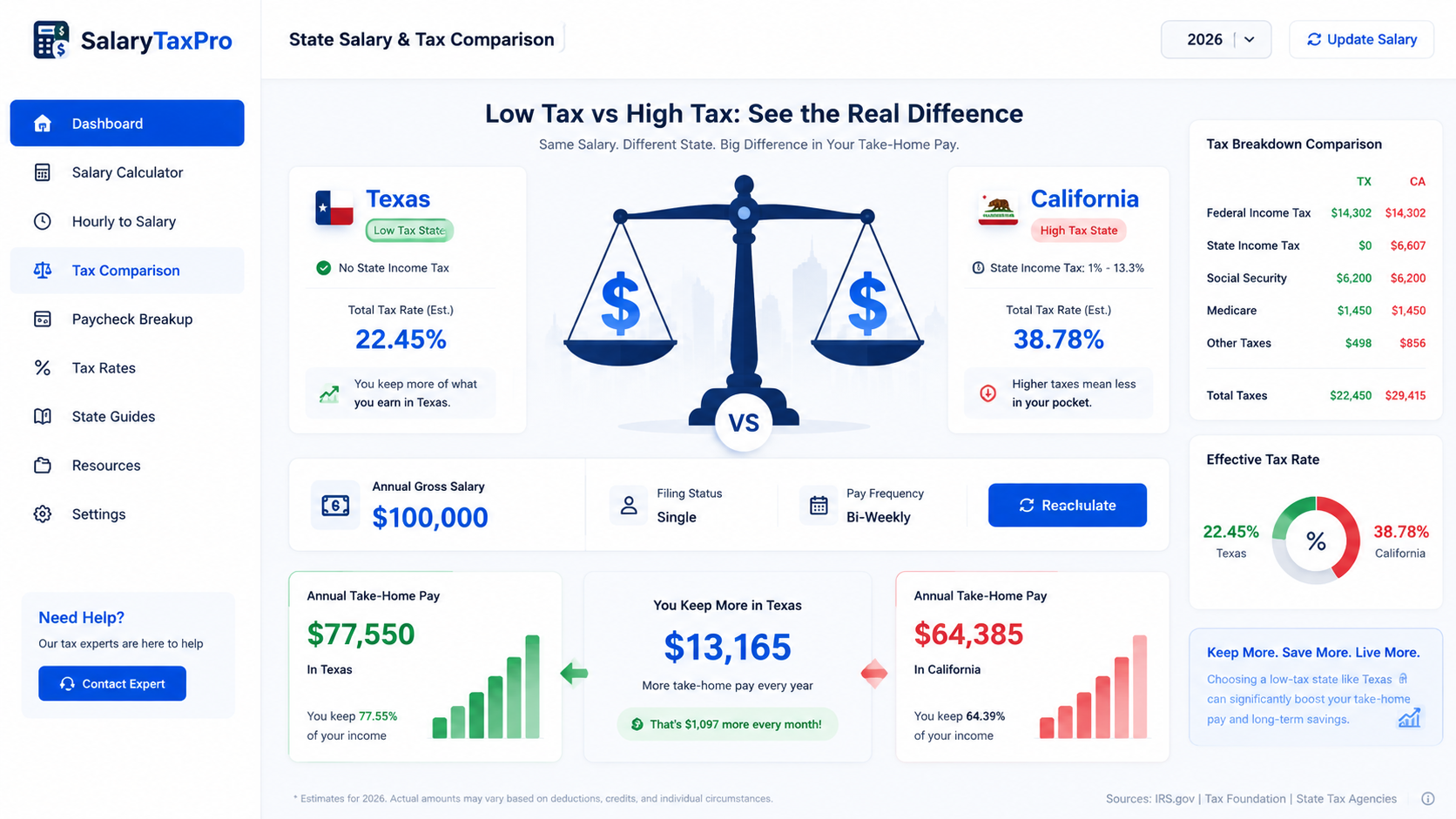
See exactly how much you’d save (or lose) by living in a low‑tax vs. high‑tax state. Enter your annual income, choose a low‑tax state and a high‑tax state, and we’ll estimate your net take‑home after federal and state taxes. This helps you make data‑driven relocation or job decisions.
Select two states to see the difference in your annual net take‑home pay. Federal taxes are estimated using 2026 brackets.
*Estimates using 2026 federal brackets, standard deduction for single filer, and simplified state effective rates. Does not include local taxes (e.g., NYC). FICA not shown but consistent across states.
How to Use This Calculator for Your Financial Planning
Follow these steps to make the most of the tool:
- Enter your annual gross income (pre‑tax, before any deductions).
- Choose a low‑tax state – we’ve pre‑selected Texas, but you can pick Florida, Alaska, or even a flat‑rate state like Pennsylvania.
- Choose a high‑tax state – California, New York, New Jersey, etc.
- Click Compare Take‑Home Pay – you’ll see federal tax (2026 brackets, standard deduction), state tax, net pay, and the annual dollar difference.
Results are instant. Use this to evaluate job offers, relocation decisions, or retirement planning.
Benefits of Understanding Your State Tax Burden
- ✔ Maximize disposable income – thousands of extra dollars per year.
- ✔ Remote work decisions – choose where to live based on tax efficiency.
- ✔ Retirement planning – retirees often move to no‑tax states.
- ✔ Negotiate relocation packages – know the tax hit before moving.
Real‑Life Examples of Tax Differences
Example 1: Sarah earns $120,000 as a remote software engineer. She lives in Texas (0% state tax). Her net after federal (approx $19,500) is $100,500. If she moved to California, state tax (~$8,500) would drop net to $92,000 – a loss of $8,500 per year.
Example 2: David earns $75,000 in Florida (0%). Net after federal (~$11,500) = $63,500. In New York, state tax (~$4,000) brings net to $59,500. He saves $4,000 annually by staying in Florida.
Factors Beyond Income Tax
Low income tax states often have higher sales taxes, property taxes, or fees. Texas, for example, has high property tax rates. Washington has no income tax but a high sales tax (~10%). California’s overall tax burden is high, but it offers services and climate. Always consider total cost of living.
FAQ: States with the Lowest Income Taxes
Conclusion: Choose Your State Wisely
The difference between living in a high‑tax state vs. one of the states with the lowest income taxes can be tens of thousands of dollars over a career. Use our interactive calculator to see your personal savings, and then weigh other factors like housing, schools, and quality of life. Knowledge is power – and so is keeping more of what you earn.



Hi, this is a comment.
To get started with moderating, editing, and deleting comments, please visit the Comments screen in the dashboard.
Commenter avatars come from Gravatar.
I found the discussion particularly relevant to active traders.
作品集网站 – 专业作品集的最佳实践